





Attention-deficit hyperactivity disorder (ADHD) is a neurodevelopmental disorder characterized by a persistent pattern of inattentiveness and/or hyperactivity-impulsivity (DSM-5; American Psychiatric Association, 2022; Sonuga-Barke et al., Reference Sonuga-Barke, Becker, Bölte, Castellanos, Franke, Newcorn, Nigg, Rohde and Simonoff2023). ADHD is conceptualized as a categorical disorder, but available evidence indicates that ADHD should be operationalized as a continuous construct, varying over developmental stages and different contexts (e.g., Marcus & Barry, Reference Marcus and Barry2011). ADHD demonstrates high heritability in childhood and adulthood (Eilertsen et al., Reference Eilertsen, Gjerde, Kendler, Røysamb, Aggen, Gustavson, Reichborn-Kjennerud and Ystrom2019; Larsson et al., Reference Larsson, Larsson and Lichtenstein2004), but still, studies indicate that non-genetic factors account for as much as 30%–60% of the variation in ADHD symptoms (Brikell et al., Reference Brikell, Kuja-Halkola and Larsson2015). Hence, because a considerable amount of the variation in ADHD is of a non-genetic character, identifying socio-contextual factors explaining this variation is of high relevance and points towards the importance of pursuing interventions beyond medication. Thus, in the present work, drawing on data from two Norwegian community samples, we evaluate whether reciprocal relations link ADHD symptomology with bullying victimization over time, from ages 6 to 14, based on repeated clinical interviews with parents and teacher questionnaires.
ADHD relates to the regulation of cognition, effort, and behavior, and the disorder has therefore—within a broader theoretical framework—been described as impairment in self-regulation (Barkley, Reference Barkley1997; Braaten & Rosén, Reference Braaten and Rosén2000). Even though the capacity for self-regulation increases vastly during the childhood years, a range of social factors may impede this development. One notable example is the thwarting of the need for belongingness in childhood, more precisely, being socially rejected or victimized by peers (Baumeister & Leary, Reference Baumeister and Leary1995; Stenseng et al., Reference Stenseng, Belsky, Skalicka and Wichstrøm2014, Reference Stenseng, Belsky, Skalicka and Wichstrøm2015, Reference Stenseng, Belsky, Skalicka and Wichstrøm2016). Deprived social functioning seems to hamper a variety of skills linked to self-regulation in childhood, such as executive functioning (Holmes et al., Reference Holmes, Kim-Spoon and Deater-Deckard2016), working memory (de Wilde et al., Reference De Wilde, Koot and van Lier2016), and emotion regulation (Stenseng et al., Reference Stenseng, Belsky, Skalicka and Wichstrøm2014). These widespread consequences of social impairments on self-regulation led us to speculate that victimization may impose a risk for elevated symptoms of ADHD in childhood and adolescence, especially because empirical evidence hints that the disorder is most influenced in this period of life (Larsson et al., Reference Larsson, Larsson and Lichtenstein2004).
Empirical studies spanning childhood to adolescence, simultaneously addressing facets of ADHD symptoms and peer functioning, are lacking. Also, when investigating prospective effects in children’s development, there is a risk that results concerning changes on the within-person level—which normally have been the primary focus of interest in psychology and psychiatry—might be contaminated by associations at the between-person level (Berry & Willoughby, Reference Berry and Willoughby2017). Importantly, it is desirable to control for stable unmeasured confounders, and to separate within-person effects from between-person effects by means of random-intercept cross-lagged panel modeling (RI-CLPM; see Hamaker et al., Reference Hamaker, Kuiper and Grasman2015), which is the statistical framework we apply in the present study. To our knowledge, no research has tested the potential reciprocity of ADHD and victimization from childhood to adolescence using RI-CLPM.
Victimization and ADHD – covariation or causation?
The cross-sectional correlation between ADHD and social difficulties is well documented, perhaps especially at younger ages (Hoza, Reference Hoza2007; O’Neill et al., Reference O’Neill, Rajendran, Mahbubani and Halperin2017). Children who are impatient in play, emotionally labile, and/or struggle to follow a shared plan of actions, often become less attractive playmates (Normand et al., Reference Normand, Schneider, Lee, Maisonneuve, Chupetlovska-Anastasova, Kuehn and Robaey2013). Accordingly, research indicates that children with ADHD, and those displaying symptoms of ADHD, are more likely to be victimized than their peers (Efron et al., Reference Efron, Wijaya, Hazell and Sciberras2021). Following a sample of 131 U.S. middle-school students with an ADHD diagnosis, Becker et al. (Reference Becker, Mehari, Langberg and Evans2017) reported that 57% of participants experienced at least one episode of peer victimization per week. The comparable rate of victimization among non-ADHD children at this age span is approximately 20% (Lebrun-Harris et al., Reference Lebrun-Harris, Sherman, Limber, Miller and Edgerton2019).
Victimization in childhood is associated with poorer mental and physical health in adulthood (see McDougall & Vaillancourt, Reference McDougall and Vaillancourt2015). In the prospective British National Child Development Study (N = 7,771), Takizawa et al. (Reference Takizawa, Maughan and Arseneault2014) identified a higher prevalence of depression, anxiety, and suicidality in adults who reported being victimized in childhood compared to their non-victimized peers. Notably, a range of confounders were controlled for in the analyses, such as childhood IQ, internalizing and externalizing problems, and family socio-economic status. Adulthood physical adversities have also been identified among those reporting childhood victimization, such as higher levels of inflammation and obesity (Takizawa et al., Reference Takizawa, Danese, Maughan and Arseneault2015). However, the retrospective design of the British National Child Development Study (Takizawa et al., Reference Takizawa, Maughan and Arseneault2014, Reference Takizawa, Danese, Maughan and Arseneault2015) makes it not positioned to consider the role of childhood ADHD as a distal predictor of these outcomes, simply because it was not measured, an thus a reference point of childhood ADHD was not included. This is a major concern with respect to causal considerations because adulthood outcomes linked to childhood ADHD are typically overlapping with those accrued from victimization, such as poorer physical and mental health, more social service use, and unstable social relationships (for a review, see Di Lorenzo et al., Reference Di Lorenzo, Balducci, Poppi, Arcolin, Cutino, Ferri, D’Amico and Filippini2021). Clearly, then, temporal relations between ADHD and victimization need to be illuminated in order to identify the roots of these negative outcomes: do they stem from ADHD alone, or does victimization amplify them?
Are there Bi-directional effects?
Scholars have suggested that bi-directional effects may emerge between ADHD and victimization (see e.g., Burt & Roisman, Reference Burt and Roisman2010; Vaillancourt et al., Reference Vaillancourt, Brittain, McDougall and Duku2013): children with more ADHD symptoms, due to their erratic behavior, are more likely to become victimized, which then spurs more ADHD symptoms. Empirical evidence which suggests that social belongingness is a fundamental psychological need developed to optimize safety, reproduction, and prosperity in human collectives (Baumeister & Leary, Reference Baumeister and Leary1995) appears consistent with such temporal interplay. When this need to belong is thwarted it instigates innate defense mechanisms to adapt to diminished social protection, including impulsivity, aggression, and a shift from long-term to short-term planning. Experimental studies have consistently shown that young adults’ immediate responses to rejection are distress, impaired executive functioning, and reduced self-regulation (Baumeister & Leary, Reference Baumeister and Leary1995; Baumeister et al., Reference Baumeister, DeWall, Ciarocco and Twenge2005).
In addition to these experimental findings, longitudinal studies from real-life settings point towards a bidirectional relation between ADHD and bully victimization. In a community sample of Chinese preadolescents, Tseng et al. (Reference Tseng, Kawabata, Gau and Crick2014) measured ADHD symptoms and peer rejection, peer acceptance, and number of friends over three 6-month periods, spanning a total of 18 months. Differential analyses of the ADHD subdimensions revealed that peer rejection consistently predicted more hyperactivity-impulsivity (HI) symptoms and inattentiveness (IN) symptoms and at a comparable magnitude. Further, a mediational relation was established, in that more IN symptoms predicted reduced acceptance from peers, which then resulted in more HI symptoms. Also, IN predicted a reduction in the number of friends over time, whereas HI did not. Similarly, in a community sample of Norwegian children (Stenseng et al., Reference Stenseng, Belsky, Skalicka and Wichstrøm2016), followed from age 4 to age 6, and further to age 8, teacher-reported peer rejection consistently predicted more parental-reported ADHD symptoms. A reciprocal relation emerged from age 4 to age 6, with more ADHD symptoms at age 4 predicting increased victimization at age 6. When analyzing subdimensions of ADHD, peer rejection predicted both HI symptoms and IN symptoms over both age spans. However, in this differentiated model, neither subdimension of ADHD predicted more prospective peer rejection, raising questions about the robustness of the documented reciprocity linking ADHD symptoms and peer victimization. Thus, more empirical investigations are needed—optimally using large-sample longitudinal datasets with clinical assessments of ADHD symptoms—to disentangle this potential longitudinal reciprocity.
Distinctive roles of ADHD subdimensions?
Although the aforementioned findings fail to provide unequivocal evidence of bi-directional effects, they still point toward a differentiated understanding of the interplay of ADHD and victimization over time, in which the subdimensions of ADHD may be affected differently. Nevertheless, there are arguments in favor of effects on both HI and IN from peer victimization. Findings that peer problems negatively affect the development of executive functions, such as working memory (Vandenbroucke et al., Reference Vandenbroucke, Spilt, Verschueren, Piccinin and Baeyens2018), imply reduced cognitive effort and diminished attention span, thereby suggesting that victimization instigates more IN. On the other hand, some studies imply that social rejection prompts basal physiological stress reactions (e.g., Iffland et al., Reference Iffland, Sansen, Catani and Neuner2014). These reactions, generally termed as increased physiological arousal (increased heart rate, lower skin temperature), are normally externalized as restlessness (e.g., “fidgetiness”; see Kogler et al., Reference Kogler, Müller, Chang, Eickhoff, Fox, Gur and Derntl2015), which resembles symptoms of hyperactivity in the HI dimension of ADHD. Thus, in the present study, we examined the subcategories of ADHD to determine any differentiated effects, or outcomes, related to victimization. Although carried out in a community sample, the proposed mechanism of poor social functioning, which leads to deprived executive functioning, and then to more ADHD symptoms is most likely to be pertinent across the total population because executive functioning applies to all levels of self-regulation (Halse et al., Reference Halse, Steinsbekk, Hammar and Wichstrøm2022; Stenseng et al., Reference Stenseng, Belsky, Skalicka and Wichstrøm2014, Reference Stenseng, Belsky, Skalicka and Wichstrøm2016). Accordingly, a strength of applying a community sample is that there normally is less commonality between HI and IN, because the overlap of these subdimensions tend to increase by symptom levels.
Victimization, ADHD symptoms, and internalizing problems
Although the primary focus of the present study is the role of victimization in the longitudinal fluctuation in ADHD symptoms in early and middle childhood, we acknowledge that both victimization and ADHD symptoms intersect with internalized problems. The comorbidity of internalized disorders, such as anxiety and depression, and ADHD in childhood and adolescence has been found to be in the range of .25–.35 percent (e.g., Cuffe et al., Reference Cuffe, Visser, Holbrook, Danielson, Geryk, Wolraich and McKeown2015; D’Agati et al., Reference D’Agati, Curatolo and Mazzone2019). Moreover, there are some indications that ADHD symptoms may forecast more anxiety and depression throughout adolescence (Meinzer et al., Reference Meinzer, Lewinsohn, Pettit, Seeley, Gau, Chronis-Tuscano and Waxmonsky2013). When it comes to victimization and internalizing problems, it seems plausible that social rejection—in a period of life where peer relations are imperial (Levitt, Reference Levitt2005)—may spur more negative thoughts and emotions (Troop-Gordon et al., Reference Troop-Gordon, Rudolph, Sugimura and Little2015), as well as cause irritability (Barker & Salekin, Reference Barker and Salekin2012) and stress (Troop-Gordon et al., Reference Troop-Gordon, Sugimura and Rudolph2017). When it comes to the latter, such emotional discomfort and restlessness are in part overlapping with the symptomology of ADHD (Leaberry et al., Reference Leaberry, Rosen, Fogleman, Walerius and Slaughter2018), and thus, when aiming at disseminating the specific interrelations of victimization and ADHD symptoms over time, it is advantageous to include measures of emotional problems in such efforts to control for the shared variance of these concepts (Fogleman et al., Reference Fogleman, Slaughter, Rosen, Leaberry and Walerius2019). Also, because symptoms of anxiety and depression tend to increase more among girls than boys when entering adolescence, and thus possessing different magnitudes of impacts over different developmental stages, it is pertinent to control for the effect of gender when disseminating these variables.
The current study
Even if the etiology of ADHD implicates, as it does, neurobiological origins, this does not preclude environmental influences. The need-to-belong theory (Baumeister & Leary, Reference Baumeister and Leary1995) and previous research (Stenseng et al., Reference Stenseng, Belsky, Skalicka and Wichstrøm2015, Reference Stenseng, Belsky, Skalicka and Wichstrøm2016; Tseng et al., Reference Tseng, Kawabata, Gau and Crick2014) provide a basis for anticipating socio-contextual effects, emphasizing peer rejection, and arguably victimization in particular. More precisely, we hypothesized that more victimization would predict more ADHD symptoms over time, and conversely, that more ADHD symptoms would predict more victimization over time. Moreover, we investigated the potential differential effects on/off on the ADHD subdimensions related to levels of victimization over time from an exploratory viewpoint.
Few studies have been positioned, data-wise, to test the potential reciprocal relation between victimization and ADHD symptoms throughout childhood and into adolescence in large panel studies, and thus, knowledge of such differential effects regarding the subdimensions of ADHD, HI versus IN, is currently limited. Based on findings from previous longitudinal studies, which unfortunately have been impeded by not separating within-person from between-person effects, we tested to which extent more victimization would predict more ADHD symptoms over time, and vice versa, after controlling for internalized problems, gender, and stable between-person effects. Here, relying on a community sample of 871 children, we tested reciprocal effects between ADHD symptoms and peer victimization across five measurement occasions, biennially from age 6 to age 14. ADHD symptoms were reported by parents, whereas victimization was reported by teachers. Analyses on subdimensions of ADHD and tests of gender moderating effects—the latter to explore to which extent gender may inflict differently on ADHD and victimization across developmental stages—were all conducted by means of RI-CLPM (Hamaker et al., Reference Hamaker, Kuiper and Grasman2015).
Methods
Participants and procedure
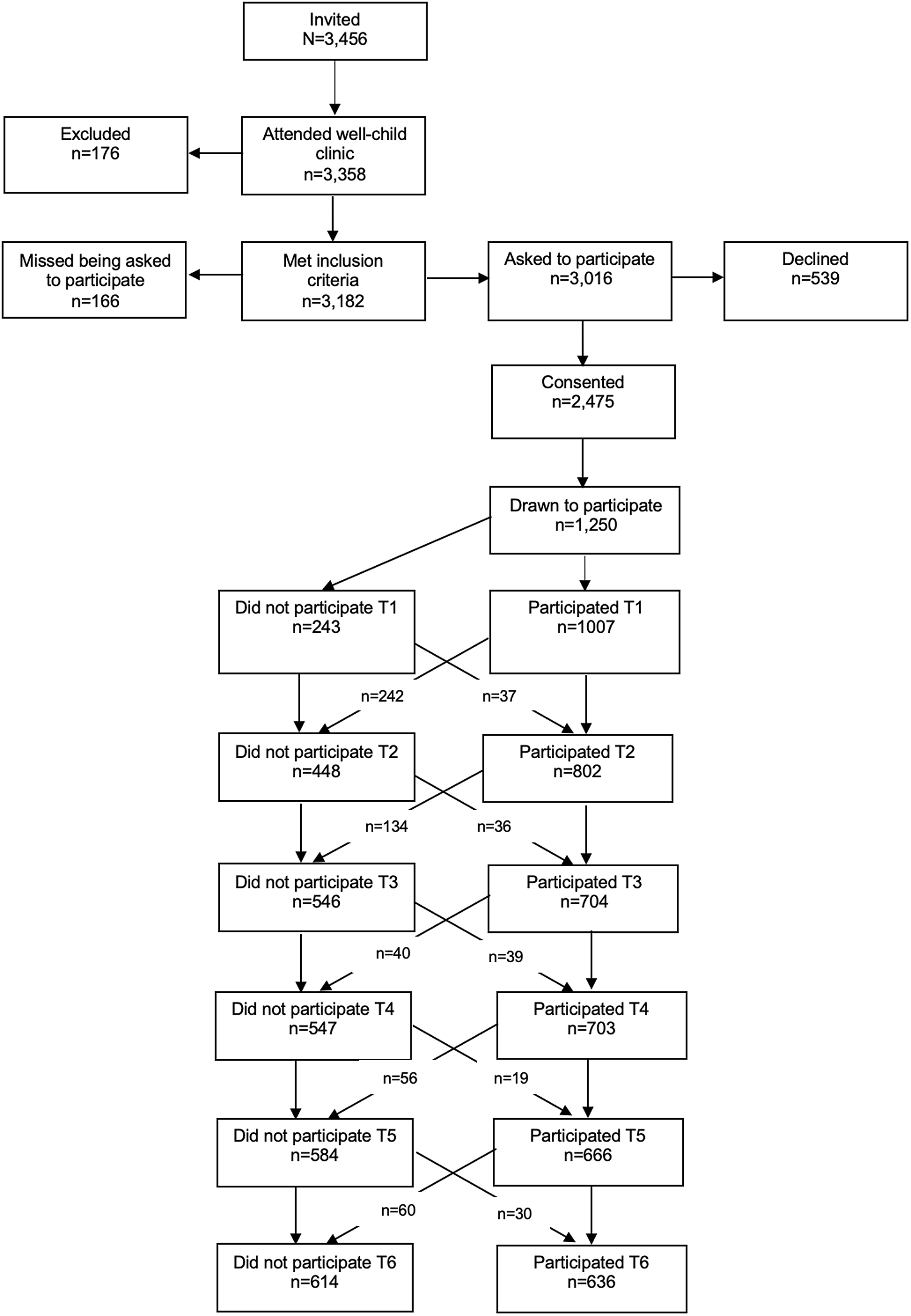
The Trondheim Early Secure Study is a representative community study conducted in Trondheim, Norway (Steinsbekk & Wichstrøm, Reference Steinsbekk and Wichstrøm2018). The first wave of the study took place in 2007 and 2008 (T1) and included children born in 2003 or 2004 when these children were 4-years-old. Subsequently, data on these children have been collected biennially, with seven assessments now completed. At the baseline, all children were invited by a letter along with the strengths and difficulty questionnaire (SDQ; Goodman, Reference Goodman1997), which is a screening instrument for emotional and behavioral problems. The parents brought the filled-in SDQ to the community health check-up for the 4-year-olds. Children with emotional and/or behavior problems, computed from their scores on the SDQ were divided into four strata (0–4, 5–8, 9–11, 12–40). Children with higher scores (37%, 48%, 70%, and 89% from the respective strata) were oversampled to increase variability and statistical power in the sample. Parents and children were then invited to the university for further testing. Accounting for these sampling weights in the analyses led to a sample that is comparable to the Norwegian population on parents’ education level and family situation (parents married, one-parent household, etc.) From a total of 1,250 children drawn to participate, 1,007 children were tested at the time of study enrollment (M age = 4.55 years; 50.6% boys). The attrition rate after consent did not vary in terms of the child’s emotional or behavioral problems or gender (Steinsbekk & Wichstøm 2018). More information on sample recruitment and follow-up is shown in Figure 1 (flowchart). The present study employs data from waves 2 to 6, corresponding to children being 6, 8, 10, 12, and 14 years old, respectively. In the analytical sample, none of the study variables was related to attrition, with the exception that victimization at age 10 predicted dropout at age 12 (OR = 1.21, p = .003, 95% CI [1.068–1.370]). At all measure points, symptoms of ADHD were sampled through a structured interview with parent(s) at the university clinic. Data on victimization was reported by teachers at all time points, through a questionnaire sent by mail to schools, with the instruction that the teacher “who knew the child/adolescent best” should respond. Response rates among teachers on the different time points ranged from 92.8% to 82.7%.
Flow chart of recruitment and follow-up in the Trondheim Early Secure Study, T1 to T7. Number of participants at the various assessment points is based on the number of participants invited to participate (n = 1,250) minus those who did not participate at the respective measurement point (i.e., T1, T2).
For each new biennial data collection, the project was reviewed by the Regional Committee for Research Ethics, Mid-Norway (www.etikkom.no; REK 4.2008.2632). A more detailed description of the procedure and recruitment process and sample can be found in Steinsbekk and Wichstrøm (Reference Steinsbekk and Wichstrøm2018).
Measures
Symptoms of ADHD
The Child and Adolescent Psychiatric Assessment (CAPA; Angold & Costello, Reference Angold and Costello2000) is a semi-structured diagnostic interview developed for assessing Diagnostic and Statistical Manual of Mental Disorders, Fourth Edition (DSM-IV) diagnoses (American Psychiatric Association, 2013). The interview follows a structured protocol using parents as informants. When a symptom is reported that corresponds with one of the criteria included in the DSM, the interviewer records the frequency, duration, and date of onset of each symptom. In accordance with the DSM-IV and DSM-5 structure of ADHD, we computed a HI and an IN scale consisting of the sum of the number of the respective symptoms. Each measure consisted of 9 items/symptoms. In the present study, the interviewers (n = 7) had at least a bachelor’s degree in a relevant field and underwent training by the team that developed the CAPA. To calculate the interrater reliability, video recordings of 9% of the interviews were re-coded by blinded raters. The reliability (intraclass correlation) for multiple pairs of blinded raters was .96 for ADHD, as measured by Preschool Age Psychiatric Assessment (PAPA; ages 4 and 6), and .90 for CAPA (age 8). The percentage of the participants with a number of ADHD symptoms above the clinical threshold (at least 6 symptoms) were varying between 7.4% at age 14 to 11.3 % at age 8.
Victimization
The Olweus Bully/Victim Questionnaire-Revised (Kyriakides et al., Reference Kyriakides, Kaloyirou and Lindsay2006; Solberg & Olweus, Reference Solberg and Olweus2003) was used to measure peer victimization on all measure points, as reported by teachers. At each measure point, the teacher who “best knew the child” was asked to report on the child. The questions were, notably, adapted to the age of the present sample at T1 (omitting the items “bullied with mean names with a sexual meaning,” “bullied with mean names about race and colour,” and “threatened to do things he/she did not want to do”). The resulting Olweus Bully/Victim Questionnaire-Revised consisted of five items, tapping closely into Olweus’ original definition of bullying/victimization: “others saying mean and hurtful things to the victim”, “is being completely ignored or excluded by peers”, “is being hit, pushed, shoved around, or threatened by others”, “are told lies or spread rumours about”, “are being stolen things from, or having things destroyed by others”. The present measure has been validated with a similar measure from preschool age and into primary school (see Stenseng et al., Reference Stenseng, Belsky, Skalicka and Wichstrøm2014, Reference Stenseng, Belsky, Skalicka and Wichstrøm2015). On each indicator of victimization, teachers rated the child on a 5-point scale: 1 (never), 2 (rare), 3 (one to three times a month), 4 (one to four times a week), and 5 (every day). A sumscore was computed for these items with a minimum mean score of 5 and a maximum of 25. Note that these items are not tapping into a latent construct but observable behaviours, partly independent of each other. Thus, being an index measure, its inter-item homogeneity was calculated using McDonald’s omega, ranging from Ω = .56 (age 6) to .77 (age 12). Acceptable omega is normally above .70, which was the case on all measure points except age 6.
Emotional problems
The CAPA (Angold & Costello, Reference Angold and Costello2000) was used to measure the child’s emotional problems across measure points. Data was collected by means of clinical interviews with parents in accordance with the DSM-IV and DSM-5 guidelines. In accordance with the CAPA manual, the trained assistants presented the symptoms from the manual verbally for the parent(s) to respond to, and the manifestation of the potential symptoms were noted by the assistant. A combined score of major depression disorder (9 symptoms), and generalized anxiety (9 symptoms), social anxiety (11 symptoms), separation anxiety (8 symptoms), and specific phobias (5 items), were computed at each measure point.
Analyses
In our main analyses, a random-intercept approach was applied (Berry & Willoughby, Reference Berry and Willoughby2017; Hamaker et al., Reference Hamaker, Kuiper and Grasman2015). This model allows testing reciprocal relations between peer victimization and ADHD symptoms at the within-person level while controlling for internalizing symptoms and also accounting for a stable between-person component, which is represented by three latent random intercepts loading on observed measures of victimization, ADHD and internalizing symptoms, respectively, across time. These random intercepts encapsulate overall levels of children’s victimization, ADHD symptoms and emotional problems as well as stable effects of time-invariant factors (see Lucas, Reference Lucas2023). The latent within-person component assesses changes from the person’s own expected scores mean level (e.g., ADHDt3 as a function of changes in one’s own levels at the previous time point, which in the current study were ADHDt2, Victimizationt2 and Emotional problemst2). In addition to the main analyses on the total number of symptoms of ADHD, to be able to determine the reciprocal effects on/from each subdimensions of ADHD, we also conducted analyses for the two subdimensions of ADHD (HI and IN), first with both ADHD-dimensions together in one model and then each ADHD-dimension in separate models. In both models, we tested our hypothesis that the cross-lagged effects between victimization and ADHD/HI and IN were consistent across measure points, as we did not expect that the strength of the relation would change with developmental age, and second, we tested whether the cross-lagged bidirectional paths between victimization and ADHD symptoms could be constrained to be equal, rather than to be freely estimated In other words, we tested whether the predictive effects from victimization to ADHD, and from ADHD to victimization did significantly differ from each other. All other paths were freely estimated. Finally, to assess whether any of the cross-lagged paths varied by gender across measure points, we tested gender moderation by means of multi-group analyses with post hoc computations of statistical significance. Missing values were treated using a full information maximum-likelihood estimator, which uses all available information in the data. Judgment of model fit was made according to the recommendations of Hu and Bentler (Reference Hu and Bentler1999; see also Marsh et al., Reference Marsh, Hau and Wen2004). Thresholds for good fit of a model are values above or close to .95 on the Comparative Fit Index (CFI) and the Tucker–Lewis Index (TLI). Values of the root mean squared error of approximation (RMSEA) and the standardized root mean squared residual (SRMR) are recommended to be less than .06 and .08, respectively. Because the sample was stratified at baseline using SDQ scores, the analyses were weighted with a factor based on the number of children in the specific stratum divided by the number of children in that stratum to arrive at accurate population estimates.
Results
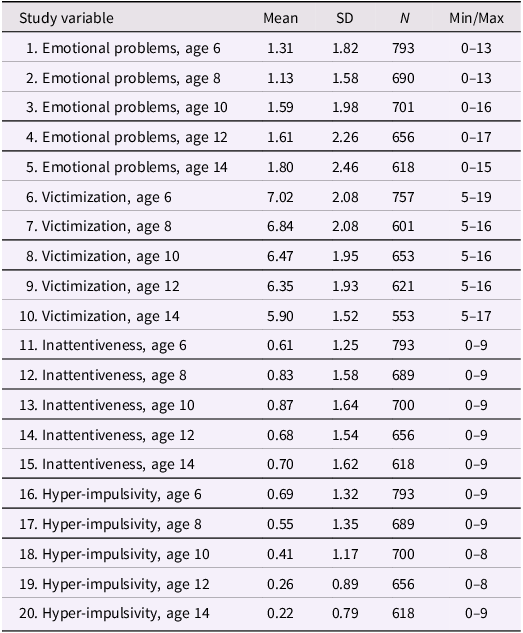
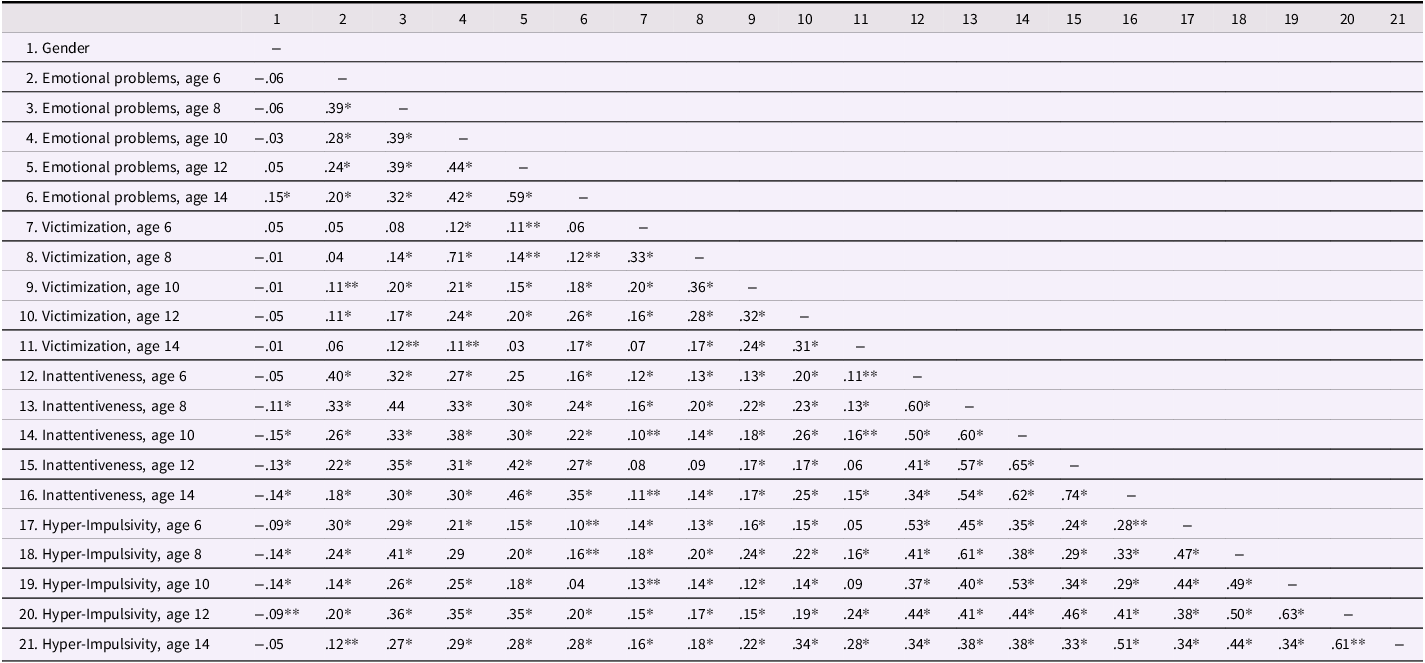
Weighted descriptive analyses, including means and bivariate correlations from Mplus 8.1 are presented in Table 1 and Table 2.
Descriptives for study variables across ages 6, 8, 10, 12, and 14
Weighted bivariate correlations for study variables across ages 6, 8, 10, 12, and 14
Analyses of reciprocal associations
In order to determine within-person effect in the potential reciprocity of victimization and ADHD symptomology, while controlling for emotional problems, we computed a RI-CLPM. The model comprising the total number of ADHD symptoms at each time point and the coetaneous level of victimization and emotional problems fitted the data well (χ 2[45] = 63.373, p = .0367, RMSEA = .022, SRMR = .032, CFI = .989, TLI = .975). At the between-person level, children with higher levels of ADHD experienced more peer victimization (r = .50, 95% CI [.28, .72]). At the within-person level, heightened levels of ADHD symptoms at age 8 predicted increased peer victimization at age 10 (β = .26, p < .26). Increased peer victimization did not significantly predict increased ADHD, however, the effect of increased victimization at age 12 predicting an increased number of ADHD symptoms 2 years later was bordering significance (i.e., at age 14 [β = .17, p = .055]).
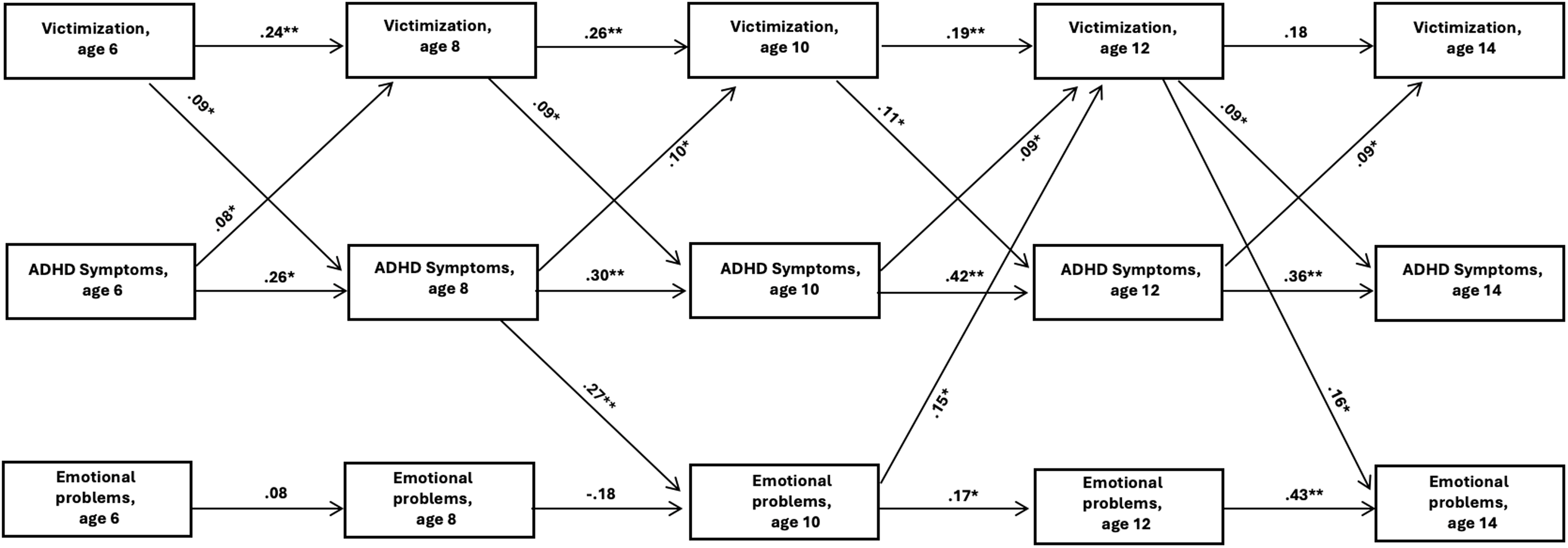
In the next step, we constrained cross-lagged paths between ADHD symptoms and victimization to be the same across time and in both directions in order to assess the stability of effects over measure points (χ 2[52] = 68.518, p = .062, RMSEA = .019, SRMR = .033, CFI = .990, TLI = .980) which did not result in a worse model fit, based on the Satorra–Bentler chi-square test (Δχ 2 = 5.17 [7], p = .639; Satorra & Bentler, Reference Satorra and Bentler2001). This simpler, and more parsimonious model implied that the size of cross-lagged effects did not significantly vary over time. In addition, the size of the effects of ADHD in predicting increased victimization and of victimization predicting increased ADHD were not significantly different from each other, indicating a reciprocal relationship over time. The unstandardized cross-lagged estimate was B = .09, p = .027, and the standardized βs ranged from .08 to .11 (see Figure 2).
Simplified model of random-intercept analysis of within-person effects between victimization and ADHD symptoms and internalizing problems for ages 6–14, with constrained cross-lagged paths for ADHD and victimization. * p < .05. ** p < .01. Figure 2 displays within-person associations (with autoregressive paths, and only significant cross-lagged paths are shown). Cross-lagged paths between victimization and ADHD symptoms were constrained to be equal across time in both directions. Concurrent correlations and correlations between random intercepts are not depicted to minimize complexity.
Analyses on subdimensions
We fitted a RI-CLPM involving the IN and HI subdimension of ADHD and victimization, controlling for internalizing symptoms, with all cross-lagged paths freely estimated, yielding a good model fit (χ 2[86] = 157.400, p <.001, RMSEA = .031, SRMR = .035, CFI = .974, TLI = .942; see Figure 3). Increased victimization at age 12 predicted increased symptoms of IN at age 14 (β = .13, p = .03). Increased IN at age 10 predicted increased victimization at age 12 (β = .15, p = .049). No significant paths were detected between victimization and HI in either direction. In the next step, we constrained cross-lagged paths between IN symptoms and victimization to be the same across time and in both directions (χ 2[93] = 167.262, p < .001, RMSEA = .030, SRMR = .038, CFI = .973, TLI = .944), with all other paths being freely estimated. This simpler model was not significantly poorer than the unconstrained model (Δχ 2 = 9.61 [7], p = .212), indicating a reciprocal relationship of victimization and IN across time points. The unstandardized cross-lagged estimate was B = .05, p = .02, and the standardized βs ranged from .02 to .08 (see Figure 3).
Simplified model of random-intercept analysis of within-person effects between victimization and hyperactivity-impulsivity, inattentiveness symptoms, and internalizing problems for ages 6–14. * p < .05. ** p < .01. Figure 3 displays within-person associations (with autoregressive paths, and only significant cross-lagged paths are shown). Cross-lagged paths between victimization and inattentiveness were constrained to be equal across time and in both directions. Concurrent correlations and correlations between random intercepts are not depicted to minimize complexity.
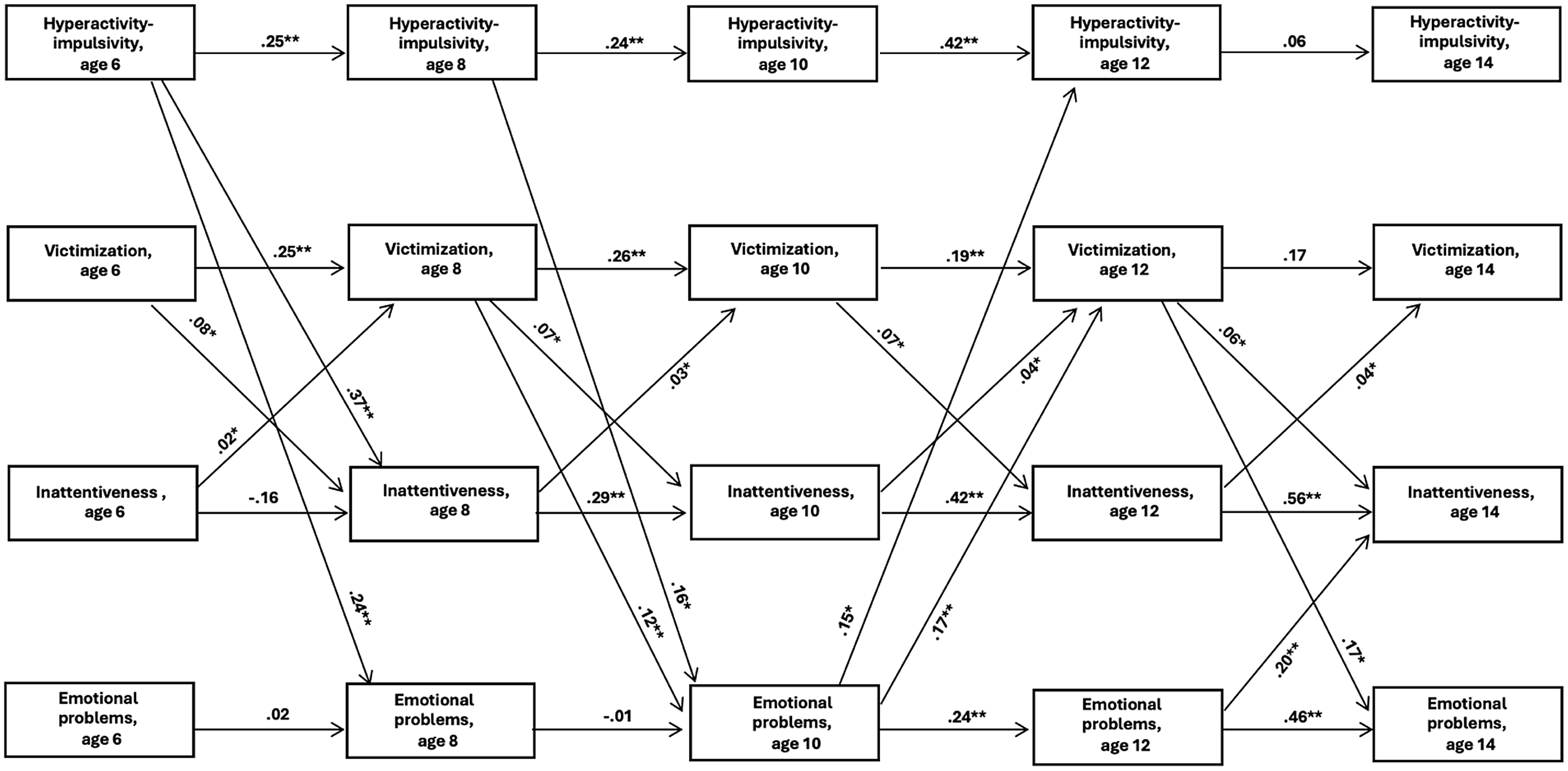
To be noted, increased victimization at age 8 (β = .12, p = .01) and at age 12 (β = .17, p = .04) predicted increased emotional problems two years later (i.e., at age 10 and 14, respectively). Increased emotional problems at age 10 predicted increased victimization at age 12 (β = .17, p = .01) and increased HI at age 12 (β = .15, p = .03). In addition, increased emotional problems at age 12 predicted increased IN at age 14 (β = .20, p = .005). HI at age 6 predicted increased emotional problems at age 8 (β = .24, p = .003) and increased IN at age 8 (β = .37, p < .001). Finally, increased HI at age 8 predicted increased emotional problems at age 10 (β = .16, p = .02). The explained variance at the within-person level ranged from 12% to 44 % for IN, 7 to 21 % for HI, and 6 to 11 % for victimization random intercepts of inattention and victimization correlated at the between-person level (r = .46, 95% CI [.28, .63]).
In multigroup analyses by gender, a model with each cross-lagged path between IN and victimization (and vice versa) constrained to be equal between boys and girls did not prove significantly worse than a freely estimated multigroup model (Δχ 2 = 23.74 [15], p = .070), thereby yielding no evidence for varying gender moderation across time points.
Discussion
Empirical evidence raises the possibility that poor social functioning influences the development of self-regulation capacity (e.g., Baumeister et al., Reference Baumeister, DeWall, Ciarocco and Twenge2005), including ADHD symptomology (e.g., Stenseng et al., Reference Stenseng, Belsky, Skalicka and Wichstrøm2016; Tseng et al., Reference Tseng, Kawabata, Gau and Crick2014). There are also grounds for inferring a reciprocal relation in which more ADHD symptoms instigate more victimization, and more victimization instigates more ADHD symptoms (Burt & Roisman, Reference Burt and Roisman2010; Efron et al., Reference Efron, Wijaya, Hazell and Sciberras2021; Vaillancourt et al., Reference Vaillancourt, Brittain, McDougall and Duku2013). Despite this suggestive evidence, research on severe forms of peer rejection, such as victimization, and specifically whether this is longitudinally linked to ADHD symptoms throughout childhood and adolescence at the within-person level, remains limited. Also, it is unclear to which extent these effects exist independently of internalized problems, which also is known to forecast, and be forecasted by, peer victimization (Troop-Gordon et al., Reference Troop-Gordon, Rudolph, Sugimura and Little2015, Reference Troop-Gordon, Sugimura and Rudolph2017). The research reported herein sought to address these limits, finding that increased ADHD symptoms throughout childhood and early adolescence were predicted by increased peer victimization, and moreover, that increased victimization was consistently predicted by preceding increases in ADHD symptoms. However, analyses on subdimensions indicated that this reciprocity is only evident for Inattentiveness symptoms.
By implementing a statistical approach that controls for unmeasured stable effects (RI-CLPM, see Hamaker et al., Reference Hamaker, Kuiper and Grasman2015), the cross-lagged analyses of the total number of ADHD symptoms showed that increased victimization predicted an increase in ADHD symptoms, and more ADHD symptoms predicted increased victimization. These results align with previous studies on social exclusion and peer rejection in childhood, indicating that loss of social belongingness (Baumeister & Leary, Reference Baumeister and Leary1995) leads to poorer development of trait self-regulation (Stenseng et al., Reference Stenseng, Belsky, Skalicka and Wichstrøm2015, Reference Stenseng, Belsky, Skalicka and Wichstrøm2016). In addition, the results of our correlations between the random intercepts indicate that children with elevated symptoms of ADHD are more likely to experience victimization, in accordance with previous studies (Becker et al., Reference Becker, Mehari, Langberg and Evans2017; Efron et al., Reference Efron, Wijaya, Hazell and Sciberras2021).
Importantly, the current work sought to look “under the hood” of ADHD symptomology by focusing on subdimensions of this malady. Separate analyses on HI and IN showed that the detected statistical effect of victimization predicting overall ADHD symptoms was due to IN symptoms. Increased victimization predicted increased IN across all ages; that is, those children who were reported by teachers to experience increased victimization were more likely to display an increase in parent-reported IN symptoms 2 years later. Moreover, a consistent reciprocal pattern was also documented, with increased IN symptoms predicting increased victimization 2 years later across all measurement occasions. Hence, a within-person reciprocal relation emerged for victimization and IN at every biennial measure point from age 8 to age 14, while controlling for effects of unmeasured and stable confounders.
A third set of findings revealed that cross-sectional overlaps between victimization and IN symptoms were considerable throughout the period (in the RI-CLPM) from childhood to adolescence. This underlines the extent to which this subdimension of ADHD symptoms is intertwined with social functioning from middle childhood to adolescence, both cross-sectionally and bi-directionally. The HI dimension did not show any such significant correlations with victimization in the model, calling into question whether this subdimension is relevant when estimating vulnerability for victimization, and evidently highlighting the differential associations of the two dimensions to levels of victimization.
There are few compelling explanations as to why IN symptoms were found to be reciprocally related to victimization, whereas HI was not. To speculate, HI symptoms may be the cluster of symptoms that are most closely linked to the neurobiological origins of the ADHD disorder, tapping into its most physiological traits (e.g., restlessness; see Leaberry et al., Reference Leaberry, Rosen, Fogleman, Walerius and Slaughter2018; Slater et al., Reference Slater, Joober, Koborsy, Mitchell, Sahlas and Palmer2022). In fact, levels of HI symptoms seem to wane in concordance with physical maturation throughout childhood and towards adulthood, while the occurrence of IN symptoms is more stable (Döpfner et al., Reference Döpfner, Hautmann, Görtz-Dorten, Klasen and Ravens-Sieberer2015). Of notice, Leopold et al. (Reference Leopold, Christopher, Burns, Becker, Olson and Willcutt2016) found that the longitudinal development of HI and IN were differently related to overall functional impairment (in social, academic, and recreational domains). HI only marginally predicted more impairment, whereas IN substantially and consistently did so in all domains. Likewise, more functional impairment predicted more IN. Although these findings do not involve social problems directly, such as peer rejection or victimization, they would seem to help explain why IN emerged as the subdimension of ADHD that most strongly co-varied with—and proved dependent upon—concrete real-life contexts such as school (i.e., academic), even to the extent that reciprocity may occur. Also, the generally low level of ADHD symptoms and victimization in the current sample might also be a reason behind non-significant associations between victimization and HI.
In line with previous findings (e.g. Troop-Gordon et al., Reference Troop-Gordon, Rudolph, Sugimura and Little2015), emotional problems were found to be predicted by victimization over the intervals of age 8–10, and 12–14, and in addition, emotional problems predicted more victimization from age 10 to 12. In other words, the present study confirmed that victimization and internalized problems are interrelated over time. The present study also helps disseminate the unique cross-lagged effects of the ADHD symptomology and emotional problems, as measured by means of clinical interviews, which strengthens the notion that the two symptomologies are independently associated with victimization over time.
The methodological (prospective) and analytical approach (RI-CLPM) taken in the present study support that the detrimental psychosocial effects of victimization (externalized vs. internalized) may take different paths throughout childhood and adolescence, possibly dependent upon type of victimization (e.g. physical vs. verbal) and/or personality characteristics, as well as available emotional and social support outside of school, and so on. In a clinical perspective, the current findings highlight the relevance of the social context in the manifestation of psychological disorders in childhood and adolescence. As such, the current study suggests that the need-to-belong perspective, which originally is a general theory of socio-motivational functioning (Baumeister & Leary, Reference Baumeister and Leary1995), may represent a useful framework in the clinical setting.
Limitations
The major strengths of this study (e.g., clinical assessment, large sample size, five measure points) must be leveled against its limitations. First, the clinical assessment of ADHD symptomology based on interviews with parents was conducted by trained personnel, but not professional psychologists. Although these personnel’s educational background was related to child behavior and development, a team of experienced psychologists may have assessed the children differently in terms of the ADHD symptomology in CAPA. The same is true if the children themselves had been interviewed.
Second, the low prevalence of children with a number of symptoms indicating an ADHD diagnosis in the current sample, which made it unmanageable to conduct adequate analyses on children with an indicated diagnosis, limits the interpretation of the findings in terms of generalization to children with an ADHD diagnosis.
Third, because our study followed the children over 8 school years, the teachers reporting on each child’s level of victimization likely changed across measurement points. This imposes some uncertainty regarding the estimates of victimization over time. On the other hand, teacher-reported data on victimization is normally regarded as more valid than parental-reported data (Løhre et al., Reference Løhre, Lydersen, Paulsen, Mæhle and Vatten2011).
Fourth, the measurement of victimization used in the current study does not differentiate between different types of victimization behavior. As mentioned in the introduction, victimization may be separated into different subtypes (e.g., verbal, physical). It is conceivable that exposure to different subtypes of victimization affects ADHD symptoms differently over time. Accordingly, because being a victim overlaps substantially with bullying others (Veenstra et al., Reference Veenstra, Lindenberg, Oldehinkel, De Winter, Verhulst and Ormel2005), it would have been better to control for bullying in the analyses. Unfortunately, such data were not available.
Fifth, the total of internalized symptoms from the DSM-5 interview were combined into a sumscore, which may conceal a more detailed pattern of relationships. However, because this symptomology was not the primary interest of the present study, and that both anxiety and depression previously have been found to be associated with victimization, we chose to use a general score. Future studies should aim to dissect the more detailed interrelations of victimization and anxiety plus depression through rigorous methodological and analytical approaches.
Even though the application of RI-CLPM approach has several advantages, most importantly dissecting changes at the within-person level from the between-level, this modelling technique does not account for possible measurement error and might be biased when potentially important time-varying factors (e.g., negative life events, family situation) are omitted.
Finally, although the current sample may be representative of Norwegian children, it is rather homogenous compared to samples from other countries, which calls for validation of the current findings in other parts of the world.
Conclusion
The current findings indicate that being victimized is related to the more “hidden” parts of ADHD symptomology in childhood and adolescence, namely IN. This is arguably the cluster of symptoms least experienced as problematic by parents, teachers, or clinicians in early developmental stages (preschool, primary school), compared to the more externalized HI symptoms, which have been reported to be more closely linked to impairment in adulthood (Niina et al., Reference Niina, Eyre, Wootton, Stergiakouli, Thapar and Riglin2022). Likewise, increased IN predicted a higher likelihood of experiencing increased victimization over all ages, showing that these more latent signs of ADHD are the ones that are associated with increased vulnerability to becoming the victim of bullies. Thus, a reciprocal relation was observed, in which increased IN spurred increased victimization, and vice versa, from age 6 to age 14. In other words, this subtype of ADHD symptoms and victimization are possibly entangled throughout large parts of childhood and into adolescence. If nothing else, these dimensional results underscore the importance of focusing attention on underlying psychosocial facets in the development and the assessment of ADHD (Faraone & Biederman, Reference Faraone and Biederman1998).
Funding statement
This research was funded by the Research Council of Norway (grant #315214).
Competing interests
None.


 Open access

